TL;DR
Staying sober during the holidays is easier with a plan made before the first invitation arrives, not in the driveway.
You do not owe anyone an explanation. A short, rehearsed "no thanks" is enough.
Skipping an event, leaving early, or driving yourself are all legitimate recovery tools.
A slip is a signal to get support fast. It is not proof that you failed.
Free help is available any day: SAMHSA's National Helpline at 1-800-662-HELP (4357) or 988 for crisis.
Table of Contents
Before the gathering: build your sobriety plan for staying sober during the holidays (tips 1-4)
At the event: handling triggers, temptation, and tough conversations (tips 5-9)
Introduction
The invitation comes in November. By the second week of December, you may be dreading a dinner you used to look forward to. That dread is common, and it does not mean your recovery is weak.
Staying sober during the holidays means walking into rooms where drinking is normal, where family history is close to the surface, and where everyone is tired. This guide gives you 12 specific tips, organized by when you will need them. If you are a parent, partner, or sibling, there is a section for you too. If you are still deciding what level of care fits you, our post on PHP vs IOP vs outpatient treatment covers that, so we will not repeat it here.
Why the holidays can challenge your recovery
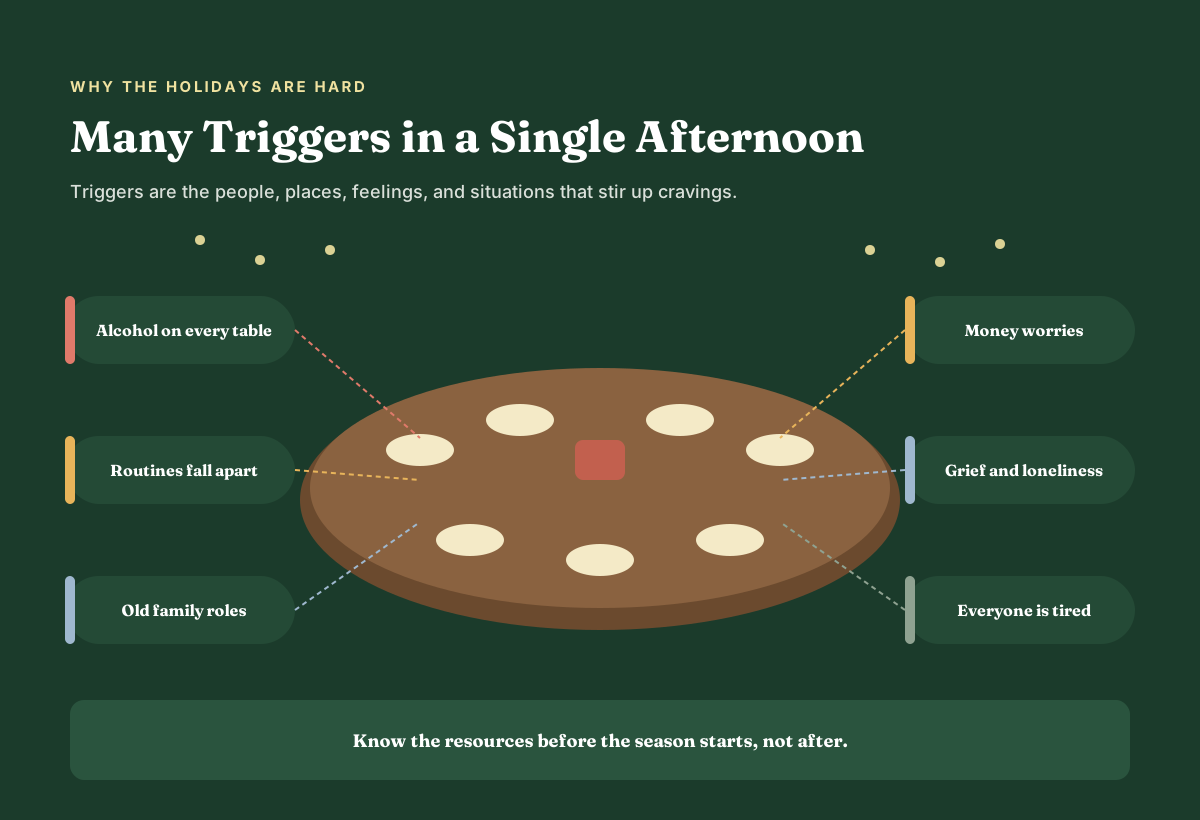
Several pressures land at once. Alcohol is on every table. Routines fall apart. You may be sitting across from the people who know your worst years, and old family roles tend to snap back into place within minutes.
Money worries, grief, and loneliness make it heavier. Clinicians call the people, places, feelings, and situations that stir up cravings "triggers." The holidays stack many of them in a single afternoon. The NIAAA, the federal agency that researches alcohol's effects on health, offers an alcohol treatment navigator and the Rethinking Drinking resource for people sorting out their next step.[1] It helps to know about them before the season starts, not after.
Before the gathering: build your sobriety plan for staying sober during the holidays (tips 1-4)
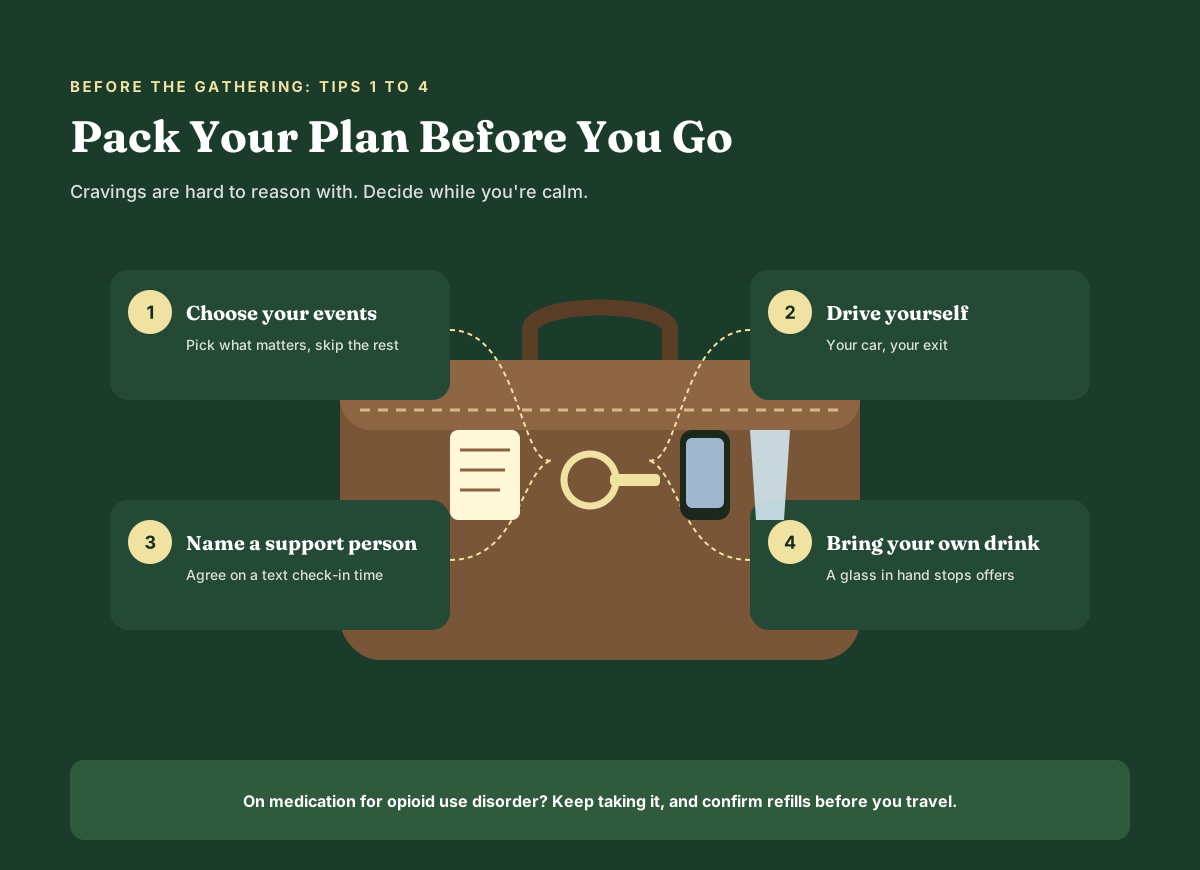
The best work happens ahead of time. Cravings are hard to reason with, so decide what you will do while you are calm.
Tip 1: Choose your events. You do not have to attend everything. Pick the gatherings that matter and say no to the rest.
Tip 2: Drive yourself. Your own car means you can leave when you need to. Do not rely on a ride from someone who wants to stay until midnight.
Tip 3: Name a support person. Pick one person, a sponsor, counselor, or friend, who knows where you will be. Agree on a text check-in at a set time.
Tip 4: Bring your own drink. Sparkling water, a favorite soda, or coffee. A glass in your hand keeps people from offering you one.
If you are on medication for opioid use disorder, keep taking it through the holidays. NIDA describes these medications as safe, effective, and life-saving.[2] Holiday travel is a good reason to confirm your supply and refills now.
At the event: handling triggers, temptation, and tough conversations (tips 5-9)
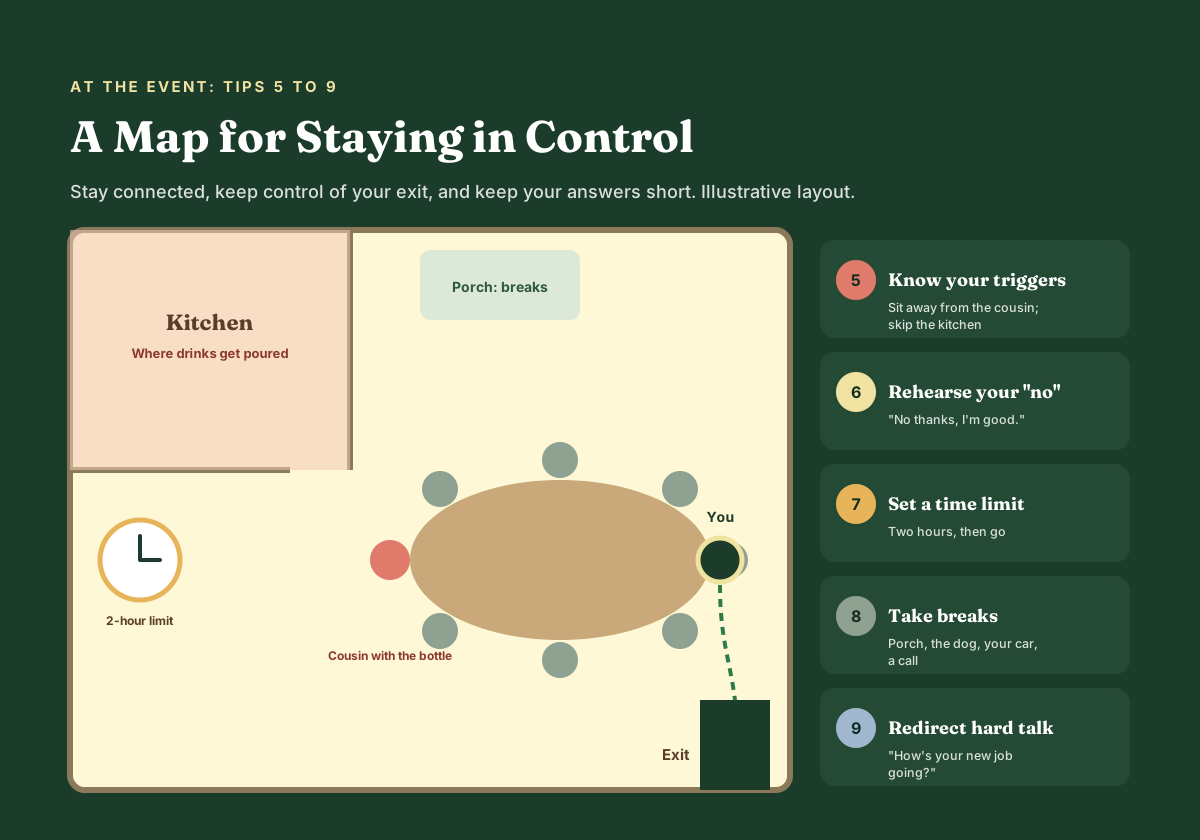
Once you are in the room, the goal is simple. Stay connected, stay in control of your exit, and keep answers short.
Tip 5: Know your triggers. If the cousin who always brings the bottle sets you off, sit elsewhere. If the kitchen is where drinks get poured, stay out of it.
Tip 6: Rehearse your "no." "No thanks, I'm good" works. So does "I'm not drinking tonight." Say it out loud before you go.
Tip 7: Set a time limit. Decide you will stay two hours. Tell the host you have another commitment if you want a cover.
Tip 8: Take breaks. Step outside, walk the dog, or sit in your car for five minutes. Call your support person if you need to.
Tip 9: Redirect hard conversations. If someone brings up your past, try "I'd rather not go into that today. How is your new job going?"
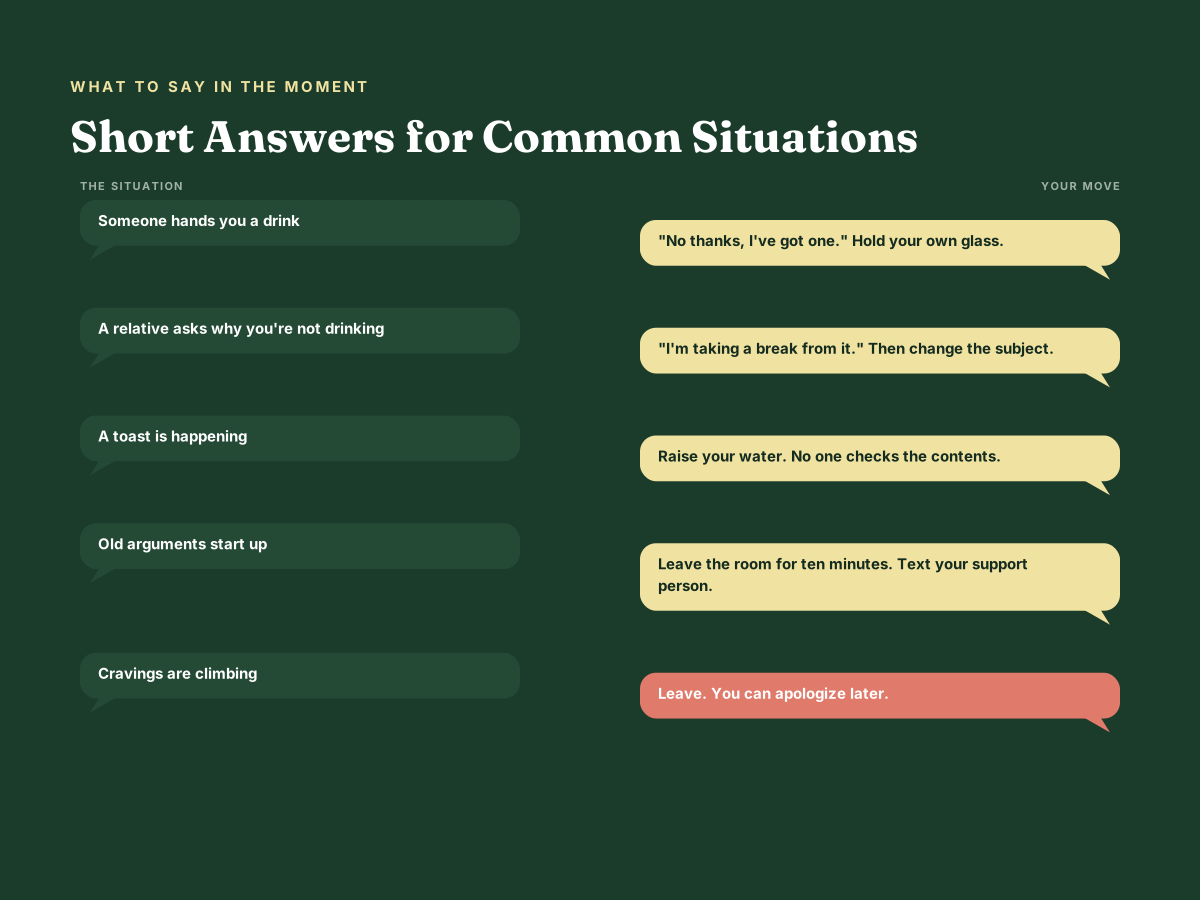
Staying sober during the holidays is often decided in small moments like these. The table below shows how to match a trigger to a response.
Situation | What you can say or do |
|---|---|
Someone hands you a drink | "No thanks, I've got one." Hold your own glass. |
A relative asks why you are not drinking | "I'm taking a break from it." Then change the subject. |
A toast is happening | Raise your water. No one is checking the contents. |
Old arguments start up | Leave the room for ten minutes. Text your support person. |
Cravings are climbing | Leave. You can apologize later. |
Taking care of yourself throughout the season (tips 10-12)
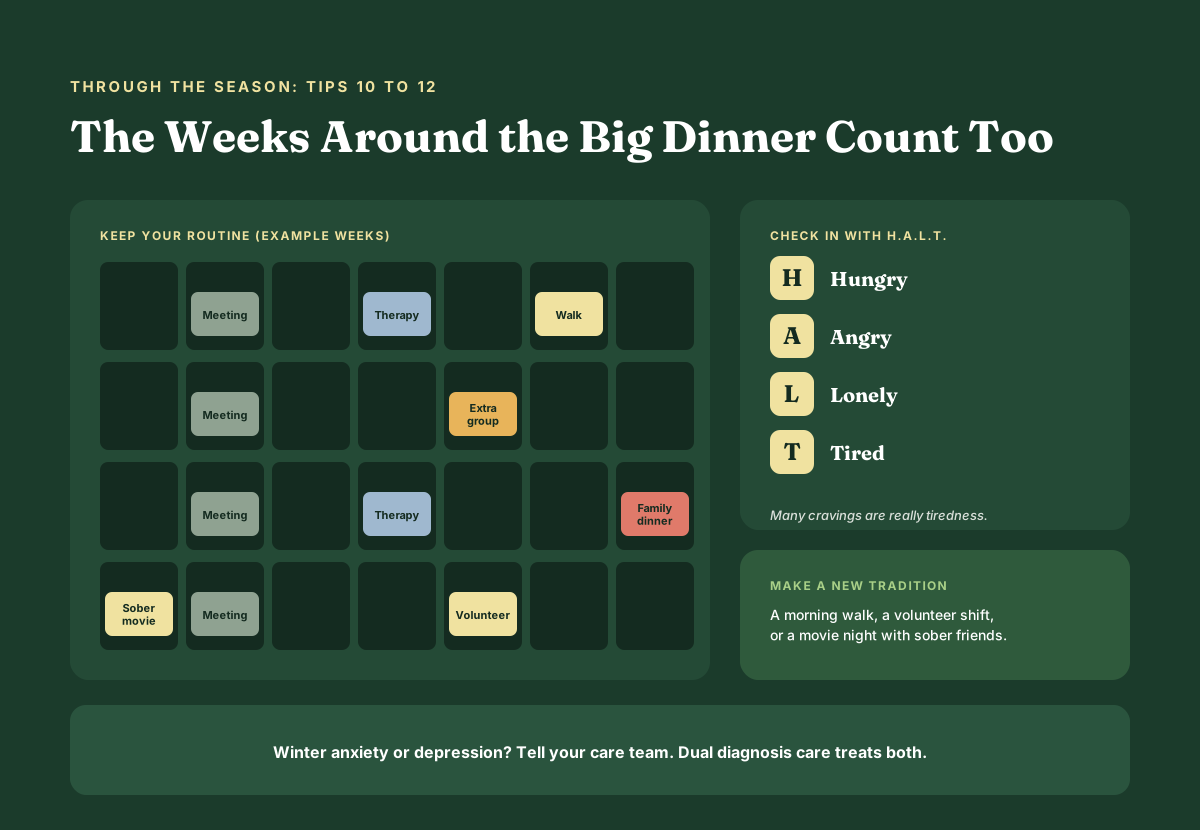
Staying sober during the holidays is not only about the big dinner. The weeks around it count too.
Tip 10: Keep your routine. Go to your meetings, therapy sessions, or group. Add extras in December if you need them.
Tip 11: Watch hunger, anger, loneliness, and fatigue. Eat real meals and sleep. Many cravings are really tiredness.
Tip 12: Make a new tradition. A morning walk, a volunteer shift, or a movie night with sober friends gives you something to look forward to.
If anxiety or depression flares in winter, tell your care team. Treating mental health and addiction together matters, and that is what our dual diagnosis treatment is built for. Skills from cognitive behavioral therapy and dialectical behavior therapy are practical here, since both teach ways to ride out a craving or a surge of emotion.
How family and friends can support a loved one's sobriety
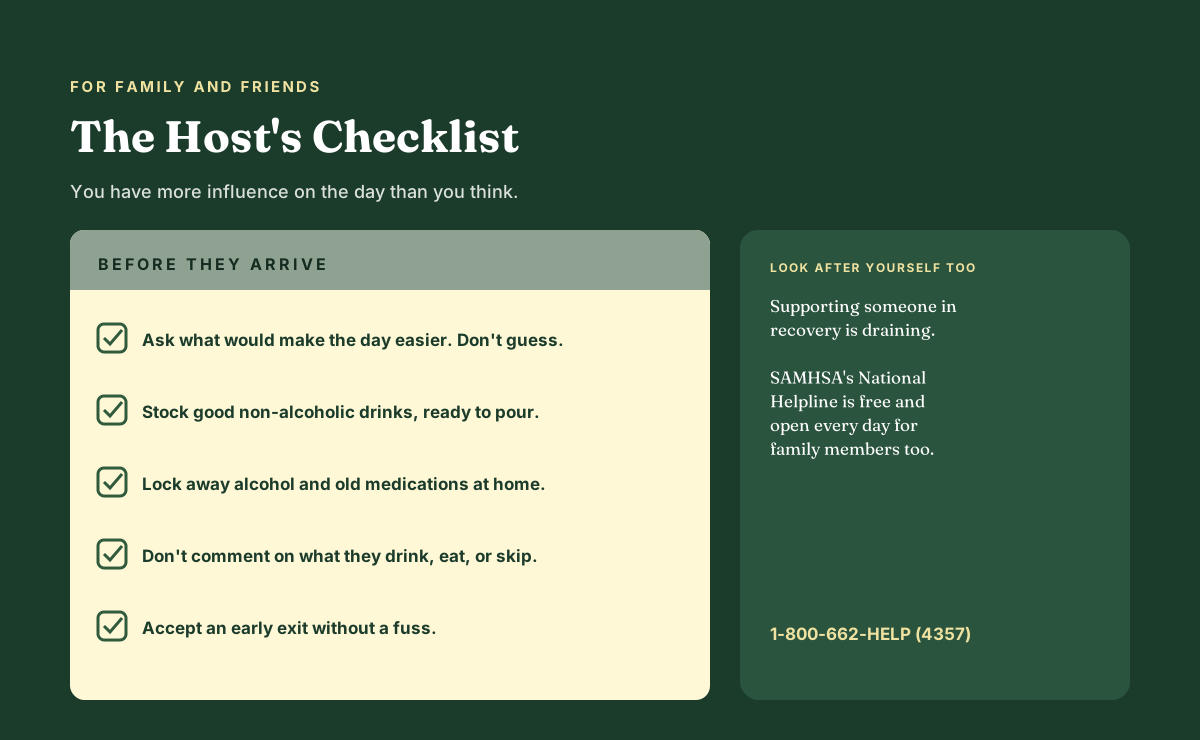
If someone you love is in recovery, you have more influence on the day than you think. Small choices help a lot.
Ask what would make the day easier. Do not guess.
Serve good non-alcoholic drinks, and do not make the person ask for them.
Do not comment on what they drink, eat, or skip.
Accept an early exit without a fuss.
Keep alcohol and old medications out of reach if the gathering is at your home.
Supporting someone who is staying sober during the holidays also means looking after yourself. Family members can lean on SAMHSA's National Helpline, which is free and open every day.[3]
What to do if you slip or feel at risk of relapse
If you drank or used, do not wait for tomorrow and do not hide it. Call your sponsor, counselor, or someone safe today. Shame is what turns a slip into a spiral.
If you feel close to using, leave the event, call someone, and go somewhere with no alcohol. If you are in danger or thinking of harming yourself, call or text 988.[3] For treatment options near you, call 1-800-662-HELP (4357) or use the SAMHSA Treatment Locator.[2]
After a slip, your treatment plan may need adjusting. The ASAM Criteria, a set of guidelines from the American Society of Addiction Medicine, use a person-centered approach to match the level of care to what a patient needs right now.[4] Sometimes that means more sessions. Sometimes it means a step up in care.
Finding support at The Ohio Recovery Collective
You do not have to white-knuckle the season alone. The Ohio Recovery Collective offers partial hospitalization, intensive outpatient, and outpatient care. We treat alcohol addiction, opioid addiction, cocaine addiction, and other substance use.
If your home is a risk, our sober living housing gives you a stable place. You can also check your insurance coverage before you call.
Frequently Asked Questions
Q: Why is staying sober during the holidays so difficult?
A: Triggers pile up. Alcohol is everywhere, routines break, family stress runs high, and old roles return. Grief and loneliness can also be sharper in winter. A plan and a support person lower the risk.
Q: How do I say no to alcohol at a family gathering without explaining my recovery?
A: Keep it short. "No thanks, I'm good" is complete. Carry your own drink, and if someone asks why, say "I'm taking a break" and change the subject. Your recovery is private.
Q: Should I skip a family event if it feels too risky for my sobriety?
A: Yes, you can. If the event is heavy with drinking or with people who pressure you, skipping it protects your recovery. You can also go for an hour, bring a support person, or see family in a calmer setting.
Q: What should I do if a family member pressures me to drink or use?
A: Repeat your answer once, calmly, then walk away or leave. You do not need to win the argument. Tell your support person afterward, and ask a trusted relative to speak with the one who pushes.
Q: What should I do if I relapse during the holidays, and where can I get help?
A: Tell someone safe today. Call SAMHSA's National Helpline at 1-800-662-HELP (4357), or 988 in a crisis. Then contact your treatment team or The Ohio Recovery Collective to restart your plan.
Conclusion
Staying sober during the holidays is a set of small decisions: which events to attend, who to text, when to leave, what to hold in your hand. None of it needs to be perfect. If the season feels like too much, or you have already slipped, call The Ohio Recovery Collective at theohiorc.com before the next invitation arrives.
References
National Institute on Alcohol Abuse and Alcoholism. National Institute on Alcohol Abuse and Alcoholism (NIAAA). - https://www.niaaa.nih.gov
National Institute on Drug Abuse. NIDA.NIH.GOV | National Institute on Drug Abuse (NIDA). - https://nida.nih.gov
Substance Abuse and Mental Health Services Administration. Home | SAMHSA. - https://www.samhsa.gov
American Society of Addiction Medicine. ASAM - American Society of Addiction Medicine. - https://www.asam.org
Are you seeking help for yourself or a loved one?