TL;DR
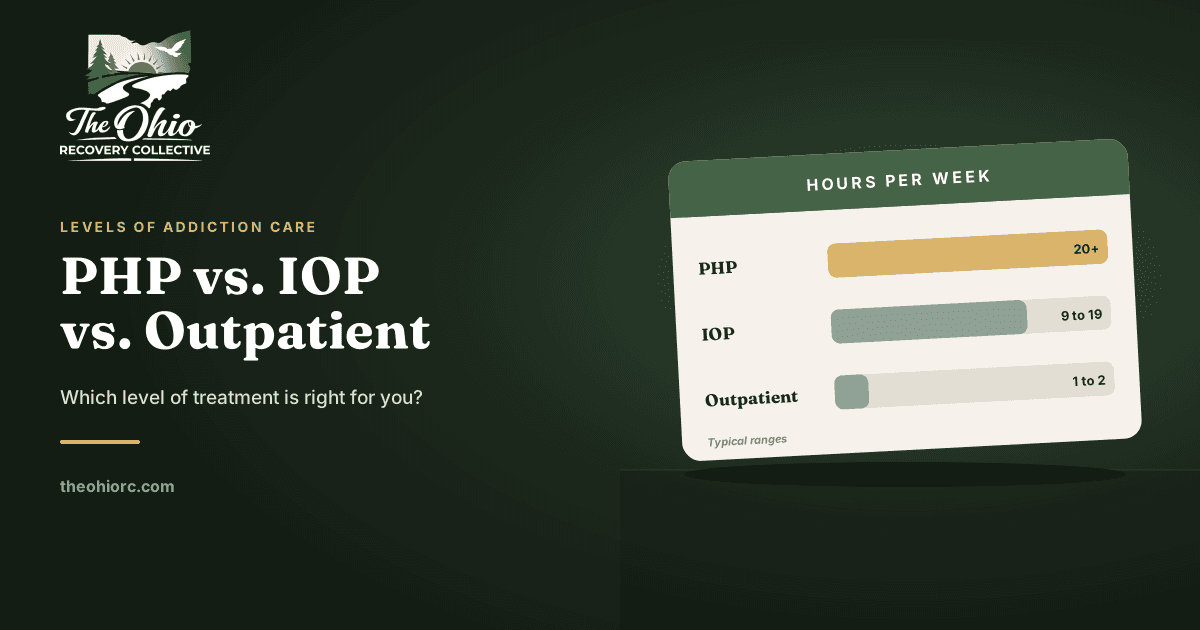
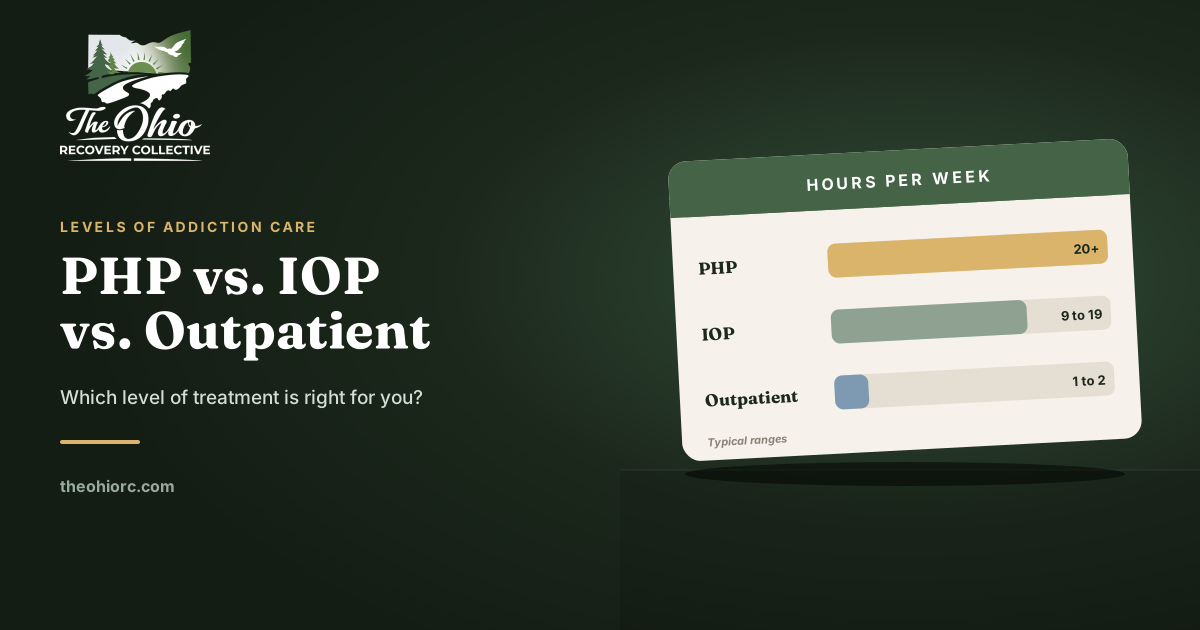
PHP, IOP, and outpatient are three levels of care. They differ mainly in how many hours per week you spend in treatment and how much daily structure you get.
PHP is the most intensive, with treatment most of the day while you live at home or in sober housing. IOP is a middle step. Outpatient is the lightest.
Clinicians use a standard framework, The ASAM Criteria, to assess your medical, psychological, and social needs. They do not pick a level by guessing.[1]
You can move between levels as you progress. Starting higher or lower than you need can both cause problems.
If you are unsure, call us. An assessment is the fastest way to get a real answer.
Table of Contents
What is an intensive outpatient program (IOP)? Who is it for?
How clinicians decide: ASAM Criteria and your personal assessment
Introduction
You have decided you need help, or someone you love has. Then you hit a wall of letters: PHP, IOP, outpatient. Nobody explains them in plain terms, and the choice feels like it could make or break everything.
It is a lot less scary than it looks. This guide covers PHP vs IOP vs outpatient in everyday language: what each one involves, who it tends to fit, and how the decision gets made. At The Ohio Recovery Collective, we offer all three, so we have no reason to push you toward one over another. The right level is the one that matches what you need right now.
Understanding the levels of addiction treatment care
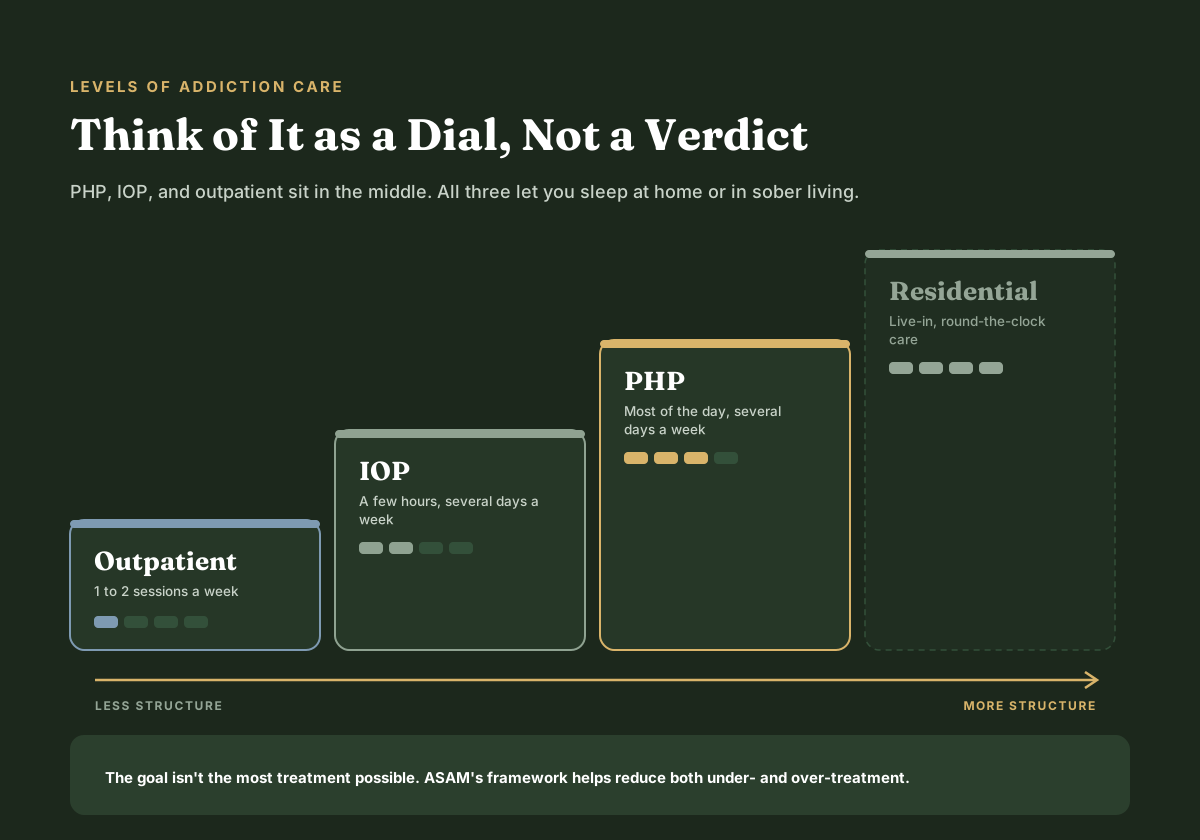
Addiction treatment is not one thing. It is a set of levels, from a few hours of counseling a week up to round-the-clock care in a hospital or residential setting. The ASAM Criteria, published by the American Society of Addiction Medicine and last updated in 2023, is a standardized way to connect people with substance use disorder to services based on their individual needs and circumstances.[1]
PHP, IOP, and standard outpatient sit in the middle of that range. All three let you sleep at home or in sober living. What changes is the time commitment and the amount of clinical support in your day. Think of it as a dial.
The goal is not to get the most treatment possible. ASAM notes that using its framework can reduce both under-treatment and over-treatment.[1] Too little care can leave you without enough support. Too much can pull you away from work and family when you do not need that.
What is partial hospitalization (PHP)? Who is it for?
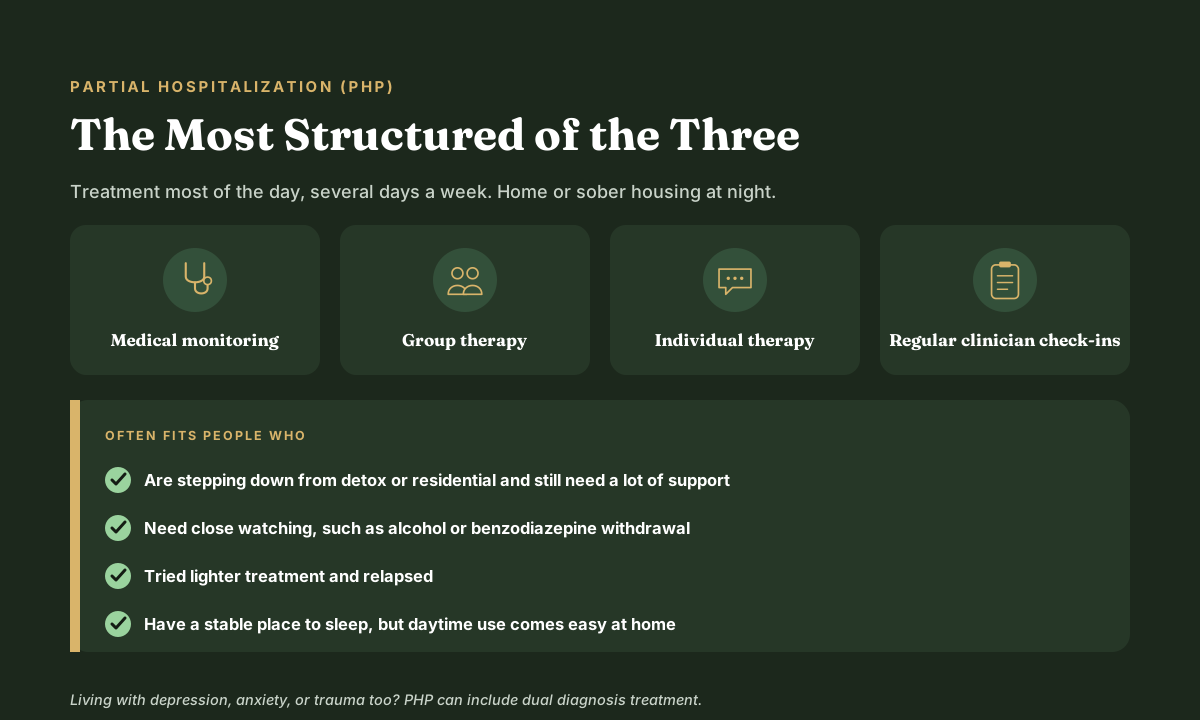
Partial hospitalization is the most structured of the three. You attend treatment most of the day, usually several days a week, then go home or to sober housing at night. Our PHP program includes medical monitoring, group and individual therapy, and regular check-ins with clinicians.
PHP often fits people who:
Are stepping down from detox or residential treatment and still need a lot of support.
Have a medical or mental health condition that needs close watching, such as withdrawal from alcohol or benzodiazepines.
Have tried lighter treatment and relapsed.
Have a stable place to sleep but a home environment that makes daytime use easy.
If you also live with depression, anxiety, or trauma, PHP can include dual diagnosis treatment, so both conditions are treated together.
What is an intensive outpatient program (IOP)? Who is it for?
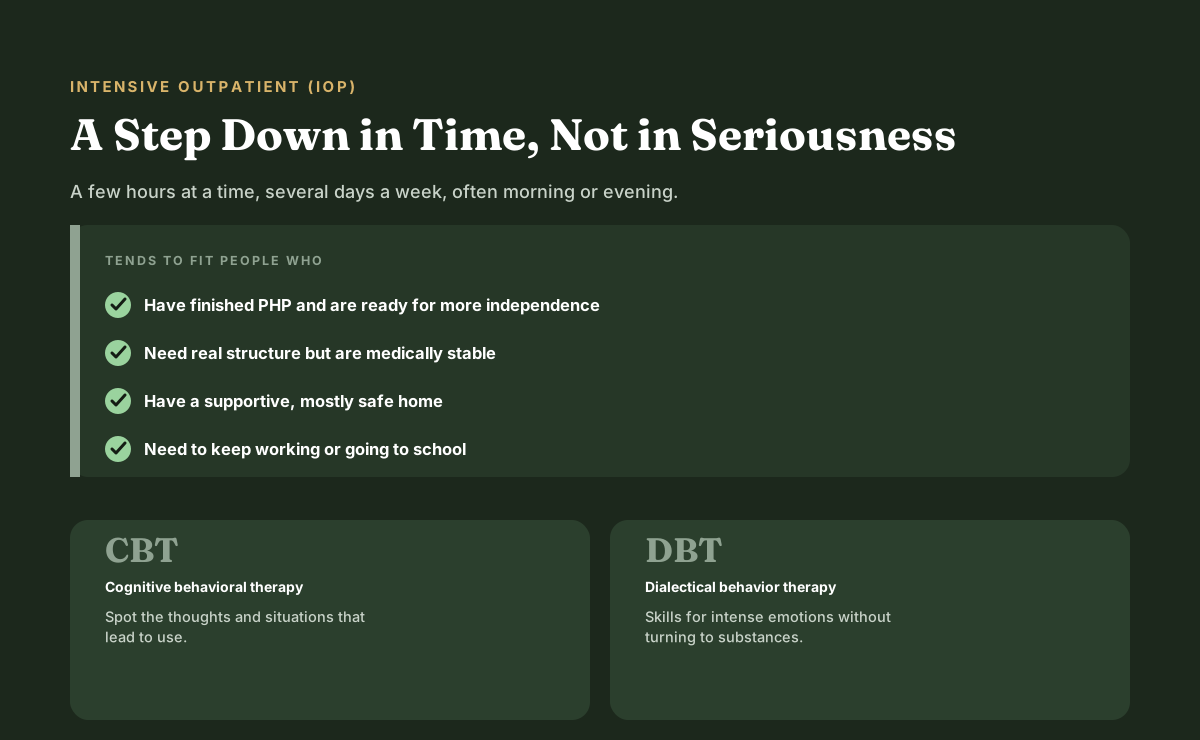
An intensive outpatient program is a step down in time but not in seriousness. You come in for a few hours at a time, several days a week, often in the morning or evening. That leaves room for a job, classes, or caring for your kids. See our IOP program for current schedules.
IOP tends to fit people who:
Have finished PHP and are ready for more independence.
Need real structure but are medically stable.
Have a supportive, mostly safe home.
Need to keep working or going to school.
Therapy at this level often includes cognitive behavioral therapy, which helps you spot the thoughts and situations that lead to use, and dialectical behavior therapy, which builds skills for handling intense emotions without turning to substances.
What is standard outpatient treatment?
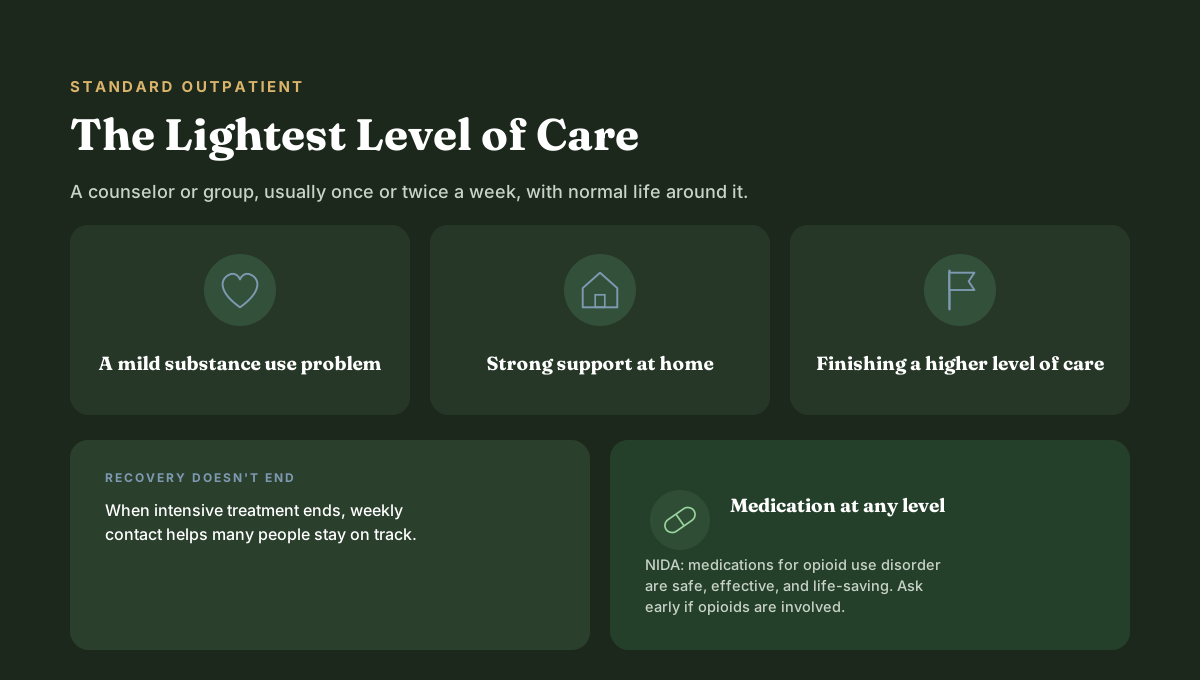
Standard outpatient is the lightest level. You meet with a counselor or attend a group, usually once or twice a week, and live your normal life around it. Our outpatient program is built for people with steady footing who want ongoing support.
It often works well for people with a mild substance use problem, people with strong support at home, and people finishing a higher level of care who want to stay connected. It is also a common long-term choice. Recovery does not end when intensive treatment does, and weekly contact helps many people stay on track.
Medication can be part of any level. NIDA describes medications for opioid use disorder as safe, effective, and life-saving.[2] If opioids are involved, ask about them early, whether it is fentanyl, heroin, or prescription pills.
PHP vs IOP vs outpatient: side-by-side comparison
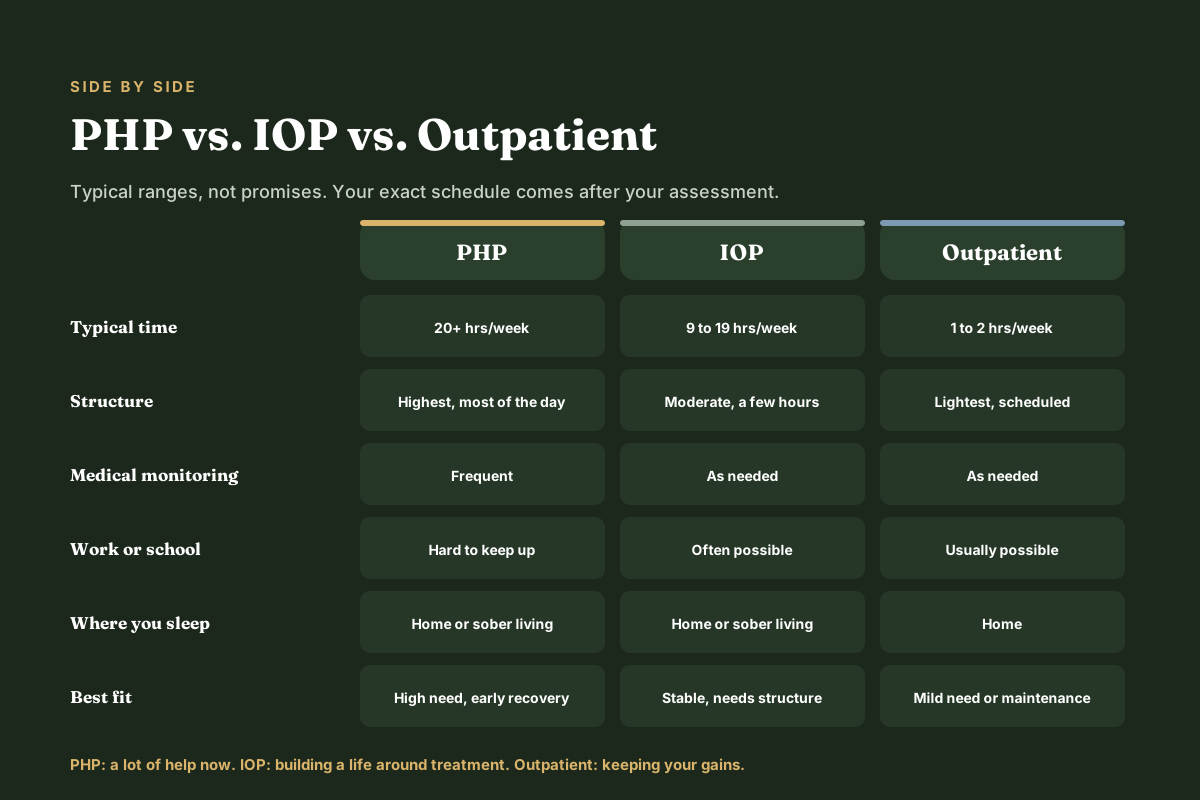
Hours vary by program and by person, so treat the numbers below as typical ranges, not promises. We will tell you the exact schedule after your assessment.
Feature | PHP | IOP | Outpatient |
|---|---|---|---|
Typical time in treatment | About 20 or more hours per week | About 9 to 19 hours per week | Often 1 to 2 hours per week |
Structure | Highest, most of the day | Moderate, a few hours at a time | Lightest, scheduled sessions |
Medical monitoring | Frequent | As needed | As needed |
Work or school | Hard to keep up | Often possible | Usually possible |
Where you sleep | Home or sober living | Home or sober living | Home |
Best fit | High need, early recovery | Stable, needs structure | Mild need or maintenance |
In short: PHP is for when you need a lot of help now, IOP is for building a life around treatment, and outpatient is for keeping the gains you have made.
If your home is not a safe place to recover, our sober living housing can pair with any of these levels.
How clinicians decide: ASAM Criteria and your personal assessment
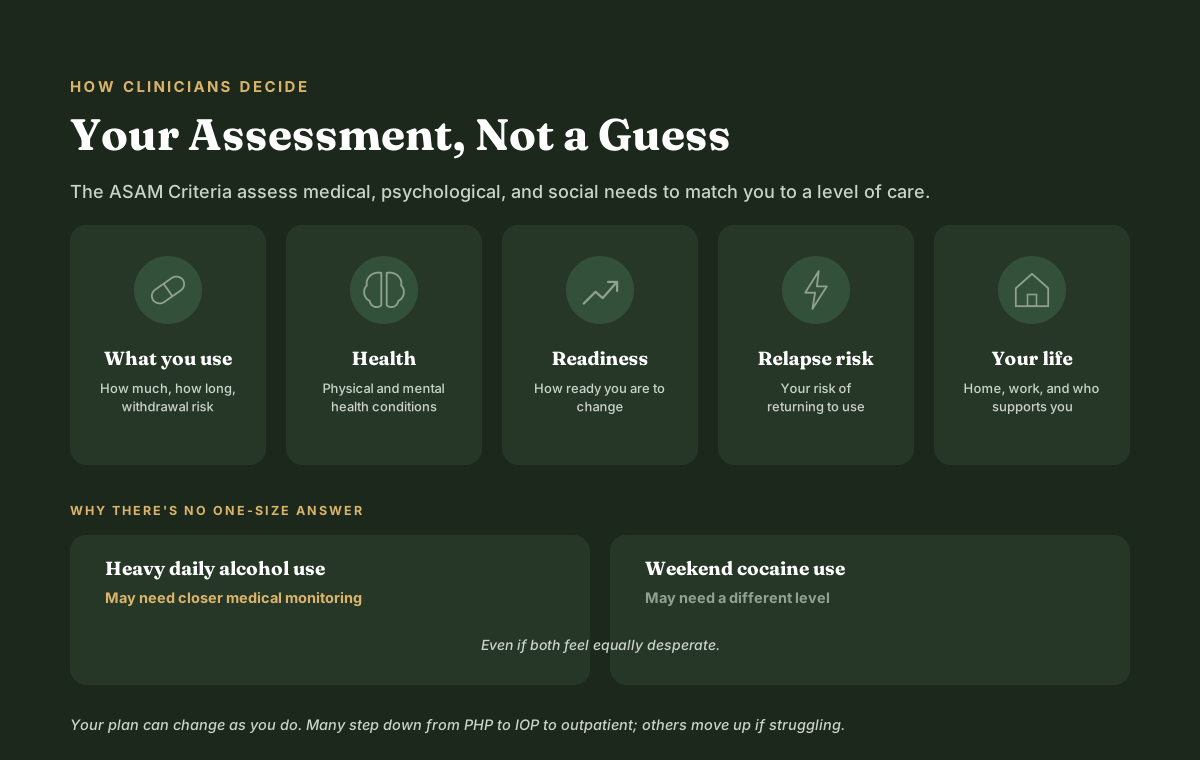
The ASAM Criteria give clinicians a consistent way to assess a person's medical, psychological, and social needs, build an individualized treatment plan, and match patients to the right level of care.[1] In practice, we ask about things like:
What you use, how much, and for how long, plus your withdrawal risk.
Your physical health and any mental health conditions.
How ready you are to change.
Your risk of relapse.
Your home, your work, and who supports you.
Your answers shape the recommendation. Someone using alcohol heavily every day may need closer medical monitoring than someone whose main struggle is cocaine use on weekends, even if both feel equally desperate. That is why the PHP vs IOP vs outpatient question has no one-size answer.
Addiction is a chronic disease that affects each person differently, and ASAM builds its guidelines around that fact.[1] Your plan can change as you do.
Taking the next step with The Ohio Recovery Collective
You do not need to have the PHP vs IOP vs outpatient question figured out before you call. That is our job. Start with an assessment, and we will explain what we recommend and why, in plain words.
Cost is a real worry, so ask about it early. Check our insurance coverage page or call us and we will go through your plan with you. SAMHSA also lists help for people with private insurance, Medicare, or Ohio Medicaid, and its treatment locator can help you compare options.[3]
If you are in crisis right now, call or text 988, or call SAMHSA's National Helpline at 1-800-662-HELP (4357).[3][2]
Frequently Asked Questions
Q: What is the main difference between PHP, IOP, and outpatient treatment?
A: Time and structure. PHP has you in treatment most of the day, IOP has you there for a few hours several days a week, and outpatient is usually one or two sessions a week. All three let you live outside a facility.
Q: How many hours per week does each level of care require?
A: Typical ranges are about 20 or more hours for PHP, about 9 to 19 for IOP, and one to two for outpatient. Exact schedules vary, and we will confirm yours after your assessment.
Q: Can I keep working or going to school during PHP or IOP?
A: Often yes with IOP, since sessions are a few hours at a time and can sometimes be scheduled around your day. PHP takes up most of the day, so working or attending school at the same time is usually hard. Some people take leave for a few weeks, and we can help you plan that.
Q: Does insurance cover PHP, IOP, and outpatient addiction treatment?
A: Many plans cover all three, but coverage depends on your plan and often on a clinical assessment showing the level is needed. We can check your benefits with you. See our insurance page to get started.
Q: Can I move from one level of care to another as I progress in recovery?
A: Yes. Many people start in PHP, step down to IOP, then move to outpatient. Others start in IOP and move up if they are struggling. Your plan is meant to change with you.[1]
Conclusion
PHP vs IOP vs outpatient is a question about how much support you need today, not a judgment about how bad things are. PHP gives the most structure, IOP balances treatment with daily life, and outpatient keeps you connected over the long run. A proper assessment sorts out which one fits.
The Ohio Recovery Collective offers all three, along with dual diagnosis care and sober living. Visit theohiorc.com or call us today to schedule an assessment. You do not have to choose alone.
References
American Society of Addiction Medicine. (2023). ASAM Criteria. - https://www.asam.org/asam-criteria
National Institute on Drug Abuse. NIDA.NIH.GOV | National Institute on Drug Abuse (NIDA). - https://nida.nih.gov
Substance Abuse and Mental Health Services Administration. Substance Use Disorder Treatment. - https://www.samhsa.gov/substance-use/treatment
Are you seeking help for yourself or a loved one?